The final week before a marathon might feel repetitive, but there’s a reason for that structure — and it works, because it’s biochemically strategic. By standardizing your meals, reducing training volume, and sticking to a sleep routine, you create physiological stability. This helps your nervous system downshift from high-alert training mode into recovery and priming mode, which is essential for performance.
For female athletes especially, consistency in nutrition and sleep helps regulate cortisol levels, optimize energy availability, and reduce inflammation — all of which are crucial to arrive at the start line hormonally balanced and neurologically calm.
Why is it important for female athletes to have a boring, homeostatic, and repetitive tapering week:
1. Cortisol Regulation
Women tend to have a more bitching hypothalamic-pituitary-adrenal (HPA) axis, which means that stress (mental, physical, or metabolic) can spike cortisol levels more easily than in men. High or fluctuating cortisol can:
Screws up with sleep
- Cortisol is the “wake up” hormone: Cortisol follows a natural circadian rhythm. It spikes in the early morning (to help you wake up), and should taper off by evening.
But when you’re stressed, anxious, over-caffeinated, or under-recovered? It stays elevated at night, making your body think it’s go time at 2 a.m. - Cortisol and melatonin have an oppositional relationship: High cortisol = low melatonin. And melatonin is what helps you fall asleep and stay asleep. So if cortisol’s high at night, your brain’s like “Nah fam, no sleep right now.”
- It raises heart rate + body temp: Your parasympathetic (rest + digest) system can’t kick in fully if cortisol’s high. Instead, you stay in sympathetic (fight or flight) mode — heart rate stays elevated, your body temp doesn’t drop, and your nervous system stays wired. That’s a recipe for shallow, fragmented sleep.
- Increases nighttime wake-ups + anxiety loops: Elevated cortisol makes it more likely you’ll wake up in the middle of the night (especially around 3–4 am) and then get caught in a mental loop of worries, future-planning, or self-doubt.
(Sound familiar? It’s why runners sometimes feel mentally scrambled even when “resting.”)
TL;DR:
Poor sleep = less growth hormone = slower tissue repair
Less deep sleep = impaired glucose metabolism = less glycogen storage
Impair glycogen storage
- Cortisol is a catabolic hormone: It breaks stuff down — including muscle proteins — to release amino acids and glucose into the bloodstream.
- Cortisol counteracts insulin: Insulin is what shuttles glucose into your muscles and liver for storage as glycogen. If cortisol is high, insulin can’t do its job as efficiently, and glucose stays in the bloodstream instead of being banked in the muscle.
🧬 Real world translation for female athletes:
If you’re stressing about performance, life, work, food decisions, last-minute workouts, or eating super low-carb (which also raises cortisol btw), your body’s like:
“Let’s not bother storing all this beautiful pasta as glycogen — we might need it for a stress emergency. Let’s keep it floating in the bloodstream just in case.”
Delay muscle recovery
- Cortisol is catabolic AF: Meaning it breaks down muscle protein into amino acids (via proteolysis) to use as fuel during stress. Great for running from lions. Horrible when you’re trying to repair muscle damage from a hard training block.
- It suppresses muscle protein synthesis: Cortisol inhibits the mTOR pathway — the master switch for muscle growth — meaning your body can’t activate the repair process efficiently.
Disrupt estrogen and progesterone balance, especially in the luteal phase
- Cortisol messes with the estrogen–progesterone balance: causing symptoms like bloating, mood swings, poor sleep, and slower recovery. It can also shorten your cycle and make training adaptations less effective.
In short: too much stress hormone = your cycle gets weird, your sleep gets worse, and your gains get ghosted.
2. Energy Availability (EA)
Female athletes are more prone to low energy availability (LEA), especially when training volume is high or eating becomes inconsistent (even unintentionally). LEA can trigger a whole cascade:
- Hormonal dysfunction (including menstrual irregularities)
- Poor recovery
- Decreased performance
- Higher risk of injury (bone, soft tissue)
In taper week, you reduce your training load but maintain or slightly increase your carb intake. That increases surplus energy availability to:
- Rebuild muscle
- Replenish glycogen
- Normalize hormonal rhythms
3. Inflammation & Gut Function
Female athletes often experience more GI distress than men, particularly under race stress. Sudden changes in fiber, fat intake, or food types can exacerbate this due to slower GI movements and hormonal effects on digestion (like prostaglandins pre-period).
Keeping your food consistent, low-fiber, and easy to digest in taper week reduces gut stress and systemic inflammation. This calms your immune system and lowers the chance of stomach cramps or mid-race emergency stops.
TL;DR:
- Consistency lowers cortisol, keeping your system in homeostasis
- Steady nutrition boosts energy availability, giving your body extra for repair
- Predictable food and sleep reduce inflammation and GI distress, especially in hormonally sensitive states
On race day, your body won’t be playing catch-up. It’ll just be ready.
RACE Taper Week Plan
Here’s how my taper week plan looked like, with a focus on low-fibre, low-sugar nutrition to support glycogen loading, maintain mental sharpness, and avoid GI (gastrointestinal) stress.
Joints-friendly, no cross-training (no weird swimming + pilates + weights, new shit combos).
Monday
- 5km easy run (slow pace, stay in zone 1, even if it feels that you’re moving to the pace of a human snail)
- Activation: Quads stretch, non-violent leg swings, T-band / glutes / calves foam rolls + fist taps
- Cooldown: Light stretching — calves, hamstrings, glutes
- Recovery: Ice massage or cold shower on legs, compression socks or the Normatec legs compression machine by Hyperice, elevate feet
- Food options: Grilled chicken or seitan, mashed potatoes, roasted carrots or courgette
- Hydration: 2–2.5 liters water + electrolytes
Tuesday
- Rest or short walk (20 min max)
- Mobility: Short yoga or hip mobility flow (no intense stretches)
- Massage: Glutes, quads, calves — foam roller or massage gun
- Food options: White rice, eggs, avocado, roasted zucchini, soft sourdough toast with salted butter
- Snack (low sugar) options: Boiled egg, rice cakes with peanut butter, small banana, blueberries
- Start reducing fibre intake (important): Avoid raw veg, beans, lentils, anything crunchy
Wednesday
- 5km easy run
- Warm-up: Short dynamic — leg swings, arm circles
- Cooldown: Light foam roll + gentle hamstring/calf stretch
- Food options: Simple pasta with olive oil + parmesan, grilled chicken, steamed courgette or carrots
- Avoid: High-fibre foods, fruit juices, bars with added sugar, fizzy drinks
- Hydration: 2.5–3L water + low-sodium electrolytes
- 🧠 Your gut should be on airplane mode: quiet and predictable.
Thursday
- 3–4km shakeout run, super light (zone 1)
- Recovery: Legs up, short calf/quad massage, compression boots optional
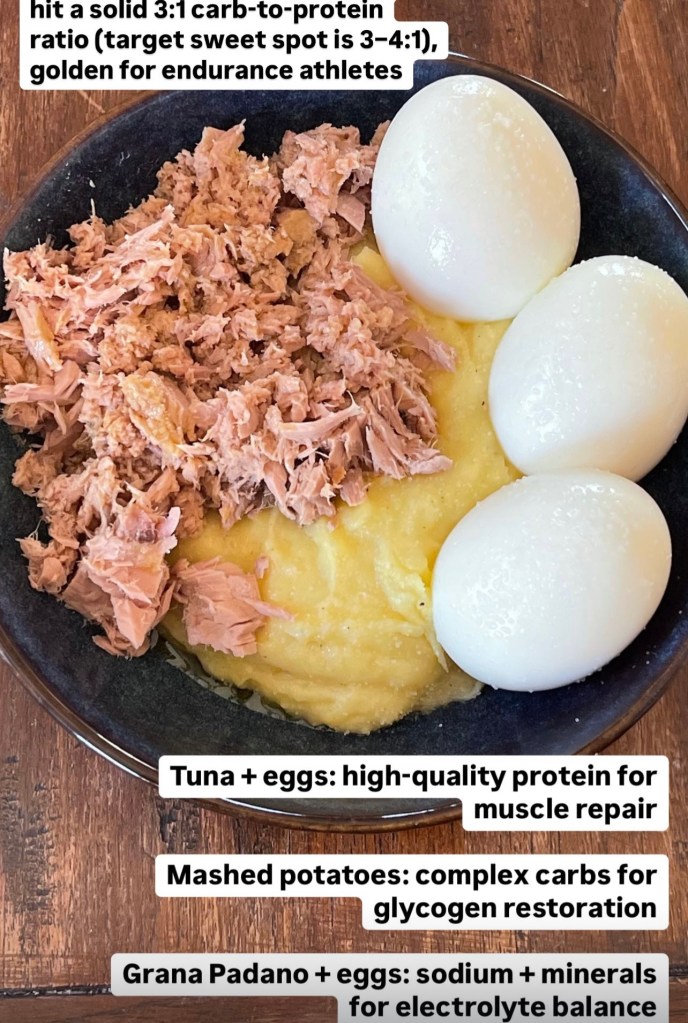
- Food options: Couscous, white rice, mashed potatoes* (I am a huge fan and addict of this dish: it’s a great energy source, and it worked really well with my body in replenishing my glycogen stores), tuna, scrambled eggs with feta, avocado
- Snack options: White bread with salted butter or PB, Greek yogurt with ripe banana or papaya
- Hydration: Sip all day — don’t flood the tank, just keep topping it up
*my mashed potatoes romance explained: perfect dish for taper week because they’re high in fast-absorbing carbs that top up glycogen stores quickly, in short essential fuel for race day. They’re also low in fibre, so they’re gentle on your gut and reduce the risk of race-day digestive drama. Plus, they’re easy to digest, cozy AF when paired with a tiny bit of salted butta and parmesan mmmyuummm. Perfect with tuna, salt and boiled eggs… I’m salivating already.
Friday
- Rest day or short walk (max 15–20 minutes)
- Mobility: Gentle yoga, hip openers, shoulder rolls, glute activation
- Mental prep: Race kit layout, gel strategy review, playlist/audiobook prep
- Food options: White pasta with parmesan, mashed potatoes, tuna or soft-boiled eggs
- Carbs up: Target your highest intake here (around 8–10g/kg body weight)
- Avoid: Veggies with skin, anything your gut doesn’t love
- Hydration: 2.5–3L, include electrolytes and some salty snacks like pretzels
Saturday
- Rest day, full calm, relaxed walkies to coffee places and just zen and loving energy overall towards all the work you’ve done and confidence in your preparation, because you’ve done so much so far!!!
- Stretching: Light only — shoulders, spine, hips. No deep holds.
- Nervous energy? Pack and repack your race kit. Walk 10–15 minutes max.
- Carb loading:
- White rice, sweet potatoes (boiled or mashed), carrots
- Plain bread, pretzels, banana
- Dinner = high-carb, low-fiber, low-fat. Done by 7–8pm
- Avoid: Spicy food, dairy (if sensitive), sauces with hidden sugar, candy
Sunday – Race Day
- Breakfast (2–3 hours before):
- White toast/bread or a bagel with salted butter or peanut butter
- Add banana if you tolerate it well
- Drink your usual caffeine (for me? 2 flat whites, no shame)
- Hydration: Small sips of water only, just enough to stay moist, not sloshy
- Optional pre-race bite: Energy gel (ONLY if you’ve tested it)
- Post-run:
- Water + protein-carb meal (grilled chicken wrap, eggs and toast, or rice bowl)
- Protein target: 15–25g within 30 minutes (or up to 60), paired with easy carbs
- Stretch lightly — don’t hammer the foam roller
- Avoid: Gorging on candy, but a square (or three) of dark chocolate = yes
- Recovery priority: Protein + carbs + salt + sleep + soft tissue work
Bonus tools:
- Daily Normatec or compression socks
- Massage gun: glutes, IT bands, calves, hammies
- Magnesium at night (especially if anxious or crampy)
- Stretch lightly—no aggressive mobility work
- Mental mantra for (my) km 38: You’ve done so much work leading to this race. Don’t waste the potential performance you could have now, only ‘cos you feel a little tired! You’ll remember this forever, make yourself proud.

 Sportiva Retreats
Leave a comment